In this article 8 sections
Last reviewed: 16 November 2026. Sources are linked in the text.
A buyer looking at a gold or silver coin, newly bought or sitting in a drawer, often wants a quick way to check it is what it claims to be. A handful of simple, non-destructive checks can be done at the kitchen table with cheap tools, and each is useful for narrowing down what a piece could be made of. None of them, alone or together, proves a piece is genuine the way a dealer’s equipment or an assay office can; they are screening tools that catch common fakes. A well-made fake, especially one built with a core metal chosen to defeat these checks, can pass some or all of them. This guide sets out six checks in order of usefulness and says where “worth doing yourself” ends and “take it to a professional” begins.
A safety note first: this guide does not cover acid testing kits, or any test that scratches, files, or marks a coin or bar. Acid testing solutions are corrosive and risk skin or eye injury if handled carelessly, and cutting or filing a piece can permanently damage or devalue it, even one that turns out genuine. If a situation seems to call for that level of testing, treat that as a sign to bring the piece to a dealer or professional, rather than attempting it at home.
1. Weight and dimensions against the Mint’s own specifications
This is the most useful check for an ordinary buyer, since it does not depend on judgment calls about sound or feel. Every coin the Royal Canadian Mint issues is manufactured to a published weight and diameter, so a counterfeiter must either match both figures in a different material or accept a piece that is measurably off. This site’s own guides to the Canadian Gold Maple Leaf and Canadian Silver Maple Leaf set out the Mint’s current official weight and diameter for the standard one-ounce coin of each metal, sourced to the Mint’s own product pages, along with the fractional sizes currently sold for gold. Checking against those current, Mint-published figures matters, since specifications can shift slightly between older and newer issues.
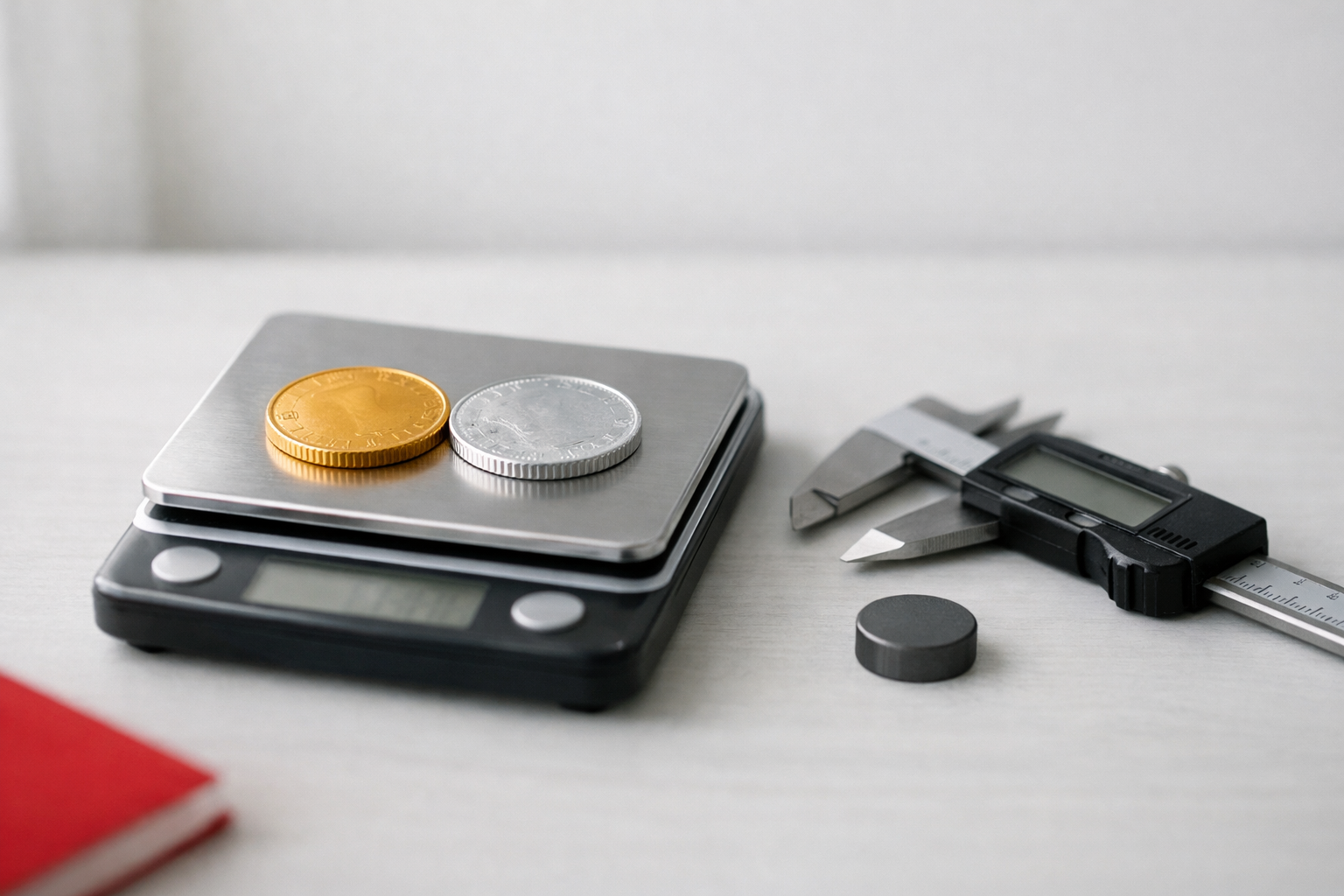
The tools are inexpensive and often already in a kitchen: a digital gram scale reading to at least a tenth of a gram, and callipers for diameter and thickness. Weigh the coin, measure its diameter, and compare both against the Mint’s specification for that exact coin and year. A coin noticeably light for its size, or off on diameter beyond normal tolerance, has failed and should not be accepted as genuine without further checking. The one limitation, covered under the density test below, is that a core metal with a density very close to gold’s can hit the correct weight and dimensions at once; the check is still worth doing, since it catches the larger share of fakes not built that precisely.
2. The magnet test
Gold and silver are both diamagnetic, weakly repelled by a magnetic field rather than attracted to it, an effect too small to feel by hand. Iron, steel, and nickel are ferromagnetic and strongly attracted to a magnet. This is standard physics, not a bullion-specific claim: Georgia State University’s HyperPhysics reference on magnetic properties of solids sets out the diamagnetic, paramagnetic, and ferromagnetic distinction and lists silver among diamagnetic metals (hyperphysics.phy-astr.gsu.edu, checked 16 November 2026).
The test itself: hold a strong rare-earth (neodymium) magnet close to the piece without touching it. A piece that pulls toward the magnet, sticks, or drags noticeably is not pure gold or silver, and very likely has an iron, steel, or nickel core or plating, a common, cheap way to fake bullion. The limit is that this only catches magnetic fakes; a non-magnetic base metal such as copper, brass, lead, or tungsten behaves exactly like genuine gold or silver in front of a magnet. A pass rules out the cheapest class of fake; it does not confirm the piece is real.
3. The ping or ring test (mainly useful for silver)
A genuine silver coin, balanced lightly on a fingertip (not held flat in the palm, which dampens the sound) and struck gently with another coin, tends to produce a long, high, bell-like ring lasting a second or more. A base-metal coin, or a heavily plated fake, tends to produce a shorter, duller thud, since the underlying metal does not resonate the same way. The contrast is usually noticeable once a buyer has heard both a known-genuine coin and a comparison piece.
This test is reasonably informative for silver, worth doing as one data point among several, not proof on its own. It is a judgment call based on sound, so it takes practice to calibrate by ear, and a few base metals can ring closer to silver’s tone than expected. A coin sealed in a hard capsule will not ring properly through the casing, which is not itself a sign of a problem. Treat a clear, sustained ring as supportive evidence, and a dull thud as a reason to look closer, not a final verdict either way.
4. Checking the Mint’s own security features
For a Royal Canadian Mint coin, there is a manufacturer-built check unrelated to weighing or sound. The Mint applies security features called Bullion DNA to Gold Maple Leaf coins dated 2014 and later, and Silver Maple Leaf coins dated 2015 and later: machined radial lines across the coin’s field, cut to within microns, creating a light-diffracting pattern; and a micro-engraved security mark, a textured maple leaf showing the last two digits of the year, visible only under magnification (Royal Canadian Mint, “Bullion DNA,” mint.ca, checked 16 November 2026).
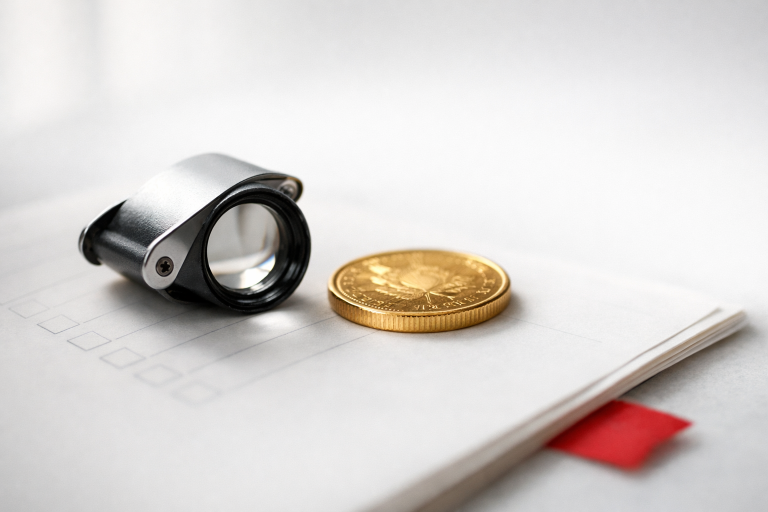
A buyer can check for both features at home with a jeweller’s loupe: the radial lines should be sharp and even, and the small engraved maple leaf mark, once located, should be crisp rather than blurred or missing. The third layer, formal Bullion DNA authentication, needs equipment a buyer does not have: a registered-dealer process where the coin is photographed and matched against the Mint’s database, worth asking a dealer to perform for a higher-value purchase. This site’s own Gold Maple Leaf and Silver Maple Leaf guides cover the full three-layer system in more detail. The Mint’s own investor guide separately notes it is rare to find counterfeit bullion circulating in Canada, while still recommending buyers check security features and buy from a known source (Royal Canadian Mint, “Buying Precious Metals” guide, mint.ca PDF, checked 16 November 2026).
5. The density test, explained correctly
This check is sometimes called a “float test,” which is a little misleading: gold and silver are both far denser than water, so a genuine piece always sinks, never floats. If something sold as solid gold or silver actually floats, or feels unusually light, that alone is a serious red flag. The more precise version does not rely on floating versus sinking; it calculates actual density and compares it to the metal’s known density.
Density is mass divided by volume. The practical way to find an irregular object’s volume at home is Archimedes’ principle: weigh the piece dry in air, then weigh it again fully submerged in water, suspended by a thread touching neither sides nor bottom, without splashing or trapping air bubbles. The difference between the two readings, in grams, equals the water displaced, in cubic centimetres, since one gram of water occupies almost exactly one cubic centimetre at room temperature. Dividing dry weight by that volume gives density, comparable to known figures: pure gold is about 19.3 g/cm³ and pure silver about 10.49 g/cm³, both well above nickel (about 8.9 g/cm³), copper (about 8.96 g/cm³), or lead (about 11.34 g/cm³) (figures per Wikipedia’s “Densities of the elements” data page, a compiled reference drawing on published physical-constants sources, checked 16 November 2026).
One blind spot is worth stating plainly: tungsten has a density of about 19.25 g/cm³, within roughly 0.3% of gold’s. A tungsten core, precisely sized and gold-plated, can match a genuine gold coin’s weight, dimensions, and calculated density closely enough that a home density test cannot tell the two apart. This is why tungsten-cored fakes concern dealers most, and why this test, like every test here, screens rather than guarantees. Silver’s density gap from common fakes is wider and more forgiving, so a buyer relying on density alone for gold should be more cautious than one checking silver.
6. When to stop testing yourself
These checks are worth doing, but they have a ceiling, and knowing where it is matters more than any one result. Stop relying on home checks and take a piece to a dealer or other qualified professional in at least three situations: when the piece is high in value relative to what the buyer can afford to be wrong about; when it fails even one check above, since a single failed test is reason enough for a second opinion rather than an explanation; and when it came from an unverifiable source, such as an unfamiliar online seller, a classified ad, or a private individual with no paperwork or traceable history.
A dealer has tools an ordinary buyer does not, including electronic conductivity testers, X-ray fluorescence analysis, and, for Mint-issued Maple Leaf coins, a registered Bullion DNA reader checked against the Mint’s database. This site’s existing guide to selling bullion back to a Canadian dealer covers what a dealer typically checks, and the companion guide on finding and vetting a local bullion dealer sets out how to confirm a dealer is a real, established business before handing anything over. For anything of real value, a professional opinion backed by equipment a kitchen table cannot match is worth more than certainty from a home test never designed to deliver it.
Dated sources
- Royal Canadian Mint, “Bullion DNA,” mint.ca/en/bullion/bullion-dna, checked 16 November 2026.
- Royal Canadian Mint, “Buying Precious Metals” investor guide (PDF), mint.ca, checked 16 November 2026.
- Georgia State University, HyperPhysics, “Magnetic Properties of Solids,” hyperphysics.phy-astr.gsu.edu, checked 16 November 2026.
- Wikipedia, “Densities of the elements (data page),” en.wikipedia.org, compiled density figures for gold, silver, tungsten, nickel, copper, and lead, checked 16 November 2026. Flagged as a secondary, compiled source for standard physical constants.
- This site’s own guides to the Canadian Gold Maple Leaf, Canadian Silver Maple Leaf, selling bullion back to a dealer, and finding a local bullion dealer, referenced above by description.
Frequently asked questions
Can I test gold or silver at home reliably?
Reliably enough to screen out most common fakes, no. A kitchen scale, callipers, a magnet, and a density check together catch the great majority of fake bullion, including most plated base-metal pieces. They will not reliably catch a well-made fake built with a core metal chosen to match gold’s or silver’s density and dimensions, such as a tungsten-cored gold fake. Treat a clean pass on every check as a reason to feel more confident, not as proof.
Is the magnet test enough on its own?
No. It only identifies pieces with a magnetic (iron, steel, or nickel) core or plating. A piece made from a non-magnetic base metal, including copper, brass, lead, or tungsten, will pass the magnet test exactly as a genuine coin would, so a pass here says nothing about those other possibilities.
What should I do if a piece fails a test?
Stop relying on home checks. A single failed test, whether an off-spec weight, a magnet pulling toward the piece, a dull ping, or a density reading that does not match the claimed metal, is reason enough to take the piece to a dealer or professional before buying, selling, or treating it as genuine.
Should I ever use acid to test a coin myself?
Only with a purpose-made kit, used as directed, with real caution, since acid testing solutions are corrosive and can injure skin or eyes if mishandled. Acid testing can also mark or damage a coin’s surface, reducing its value even if the metal is genuine. For anything with meaningful value, this is better left to a dealer or professional, rather than attempted at home.
About this byline
Gold in Canada is written by an editorial desk, not a single person. We are not advisers, and nothing here is personalized investment, tax or legal advice. Who writes this
Spotted an error? Tell us. We fix pages in place and say what changed.