
In this article 10 sections
- A mining share is a claim on a company, not on bullion
- Three TSX-listed gold miners, named only as real-world examples
- What actually drives a mining stock’s profitability
- Operating leverage: why a mining stock can move more than gold itself
- The flip side: no company risk, but no operational upside either
- Dividends: some miners pay them, physical gold and most gold ETFs do not
- Liquidity and account eligibility
- A different, higher-risk category from this site’s gold ETF guide
- Frequently asked questions
- Sources
Last reviewed: November 16, 2026. Sources are linked in the text.
This guide explains, structurally, how owning shares of a gold-mining company differs from owning physical gold. It is general educational information, not investment advice, and not a recommendation to buy, sell or hold any stock named below. Gold in Canada is not a registered investment dealer or advisor, and nothing here replaces professional advice.
Gold in Canada has no paid partnership with, and earns no commission from, any mining company named here, the same arm’s-length position this site takes toward fund managers in its gold ETF guide. Before buying any stock, read the company’s own disclosure filings and consider speaking with a registered advisor about whether it fits a portfolio.
A mining share is a claim on a company, not on bullion
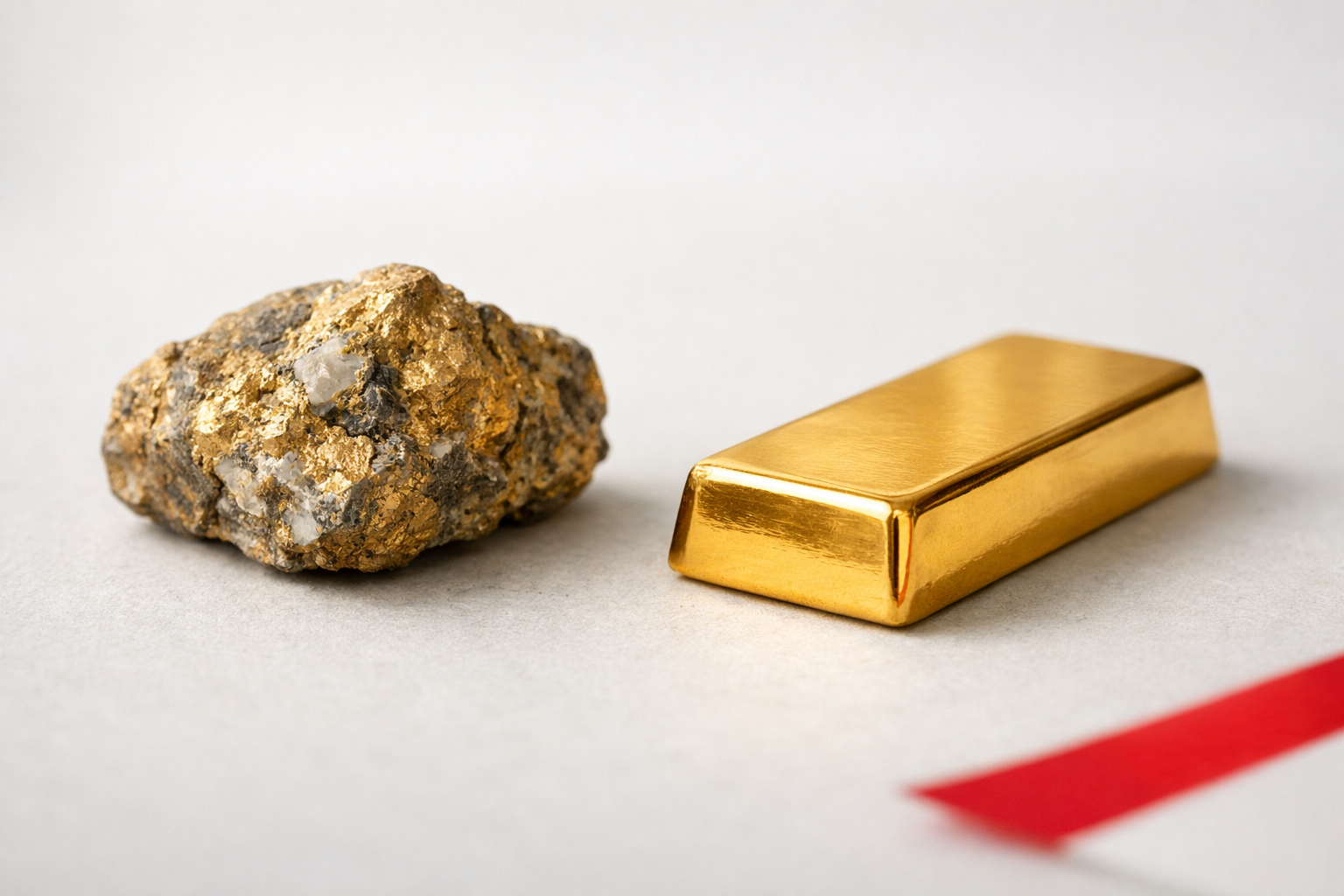
Buying a share of a gold-mining company means buying a small ownership stake in that business: its mines, equipment, cash and debt, contracts and management team. It does not mean taking delivery of gold, and the share’s value is not pegged to the gold price on a fixed ratio. A share price reflects what investors think future profits are worth, and those profits depend on far more than the price of the metal dug up.
Three TSX-listed gold miners, named only as real-world examples
The three companies below are not a recommendation, a ranking or a shortlist. They show what an individual mining stock concretely is, each confirmed as currently listed on the Toronto Stock Exchange directly from the company’s own investor-relations page rather than assumed.
Barrick Mining Corporation (TSX: ABX)
- Trades on the Toronto Stock Exchange under ABX and the New York Stock Exchange under B, per Barrick’s own investor relations page, checked Nov. 16, 2026.
- Renamed from Barrick Gold Corporation to Barrick Mining Corporation effective May 6, 2025; the TSX ticker ABX did not change, per the 2025 annual report.
- Mines span the Americas, Africa and Asia, including Nevada (U.S.), the Dominican Republic and Mali, per the 2025 annual report.
Agnico Eagle Mines Limited (TSX: AEM)
- Trades on the Toronto Stock Exchange and New York Stock Exchange, both under AEM, per the company’s investor relations page, checked Nov. 16, 2026.
- Operating mines are in Canada, Finland, Mexico and Australia, described in its own 2025 annual report as “favourable mining jurisdictions… with stable political environments.”
- Has declared a cash dividend every year since 1983, per its second-quarter 2026 results release.
Kinross Gold Corporation (TSX: K)
- Trades on the Toronto Stock Exchange under K and the New York Stock Exchange under KGC, per its third-quarter 2026 dividend release, Oct. 28, 2026.
- A Canadian-based company with operations and projects in the United States, Brazil, Mauritania, Chile and Canada, per its own company description.
- Pays a quarterly dividend, most recently US$0.04 per share declared for the third quarter of 2026.
What actually drives a mining stock’s profitability
A mining company’s profit per ounce is, at its simplest, the gold price minus what it costs to mine and sell that ounce. The cost side is where mining stocks differ most sharply from the metal itself, with several separate moving parts:
- The company’s own production costs. Industry reporting typically uses “all-in sustaining cost” (AISC) per ounce. Barrick’s 2026 guidance, reiterated Nov. 9, 2026, puts AISC at $1,760 to $1,950 per ounce against a $4,500 gold price assumption. A higher-cost producer keeps less of any given price than a lower-cost one.
- Input costs that move independently of gold. Barrick’s third-quarter 2026 release notes that “for every $10 per barrel change in the oil price, the direct impact on costs associated with diesel consumption is approximately $12 per ounce.” Fuel, labour and consumables can rise while gold sits still, squeezing margin from the cost side alone.
- Debt and balance sheet strength. Barrick’s 2025 annual report lists “financial position and liquidity” as a principal risk, since debt repayments and leverage ratios affect credit ratings and capital access. A more indebted company has less room to absorb a weak gold price than one with a stronger balance sheet.
- Management decisions on capital allocation. Boards decide how cash is split between dividends, buybacks, new development and debt repayment. Barrick’s current policy, per its Nov. 9, 2026 announcement, targets 50% of free cash flow as dividends plus a $3.0 billion buyback; a different board could choose differently with the same gold price and mines.
- Jurisdiction and geopolitical risk. Barrick’s Loulo-Gounkoto complex in Mali was placed under provisional administration by Mali’s government in 2025 amid a tax and ownership dispute, with exports blocked and operations suspended, until Barrick announced a resolution on Nov. 24, 2025. Agnico Eagle, by contrast, describes its mines in Canada, Finland, Mexico and Australia as sitting in “stable political environments,” per its own annual report. Two gold miners can carry very different jurisdiction risk.
- Exploration success. A mine eventually depletes, so a company depends on finding new reserves. Barrick’s 2025 annual report names this a principal risk, citing “the speculative nature of mineral exploration and development.” A drilling result’s success or failure changes a company’s outlook independently of gold’s price that day.
Operating leverage: why a mining stock can move more than gold itself
Because a large share of a mine’s costs do not move in lockstep with the gold price, a given percentage move in the gold price tends to produce a larger percentage move in profit margin. This is usually called operating leverage, and it is the main reason mining stocks can rise or fall by far more than gold itself, in either direction.
A simplified, hypothetical illustration using Barrick’s own 2026 guidance makes this concrete, without forecasting anything. Its AISC guidance midpoint is roughly $1,855 per ounce against a $4,500 price assumption, a margin near $2,645. A 10% price drop to $4,050, with costs held steady for simplicity, cuts margin to about $2,195, a drop near 17%, almost double the move in gold. The arithmetic runs the same way in reverse when gold rises. Operating leverage cuts both ways, which is why a mining stock is a leveraged bet on gold, not a mirror of it.
The flip side: no company risk, but no operational upside either
Physical gold carries none of the company-specific risks above. A bar or coin has no debt, no management making capital-allocation calls, no mine in a politically risky jurisdiction, and no exploration program that can fail. Its value tracks the spot price of gold directly, aside from the dealer premium and spread on buying and selling it.
What physical gold cannot do is improve its own economics. A well-run mining company can cut costs, bring a higher-grade ore zone into production, or expand output, and turn a larger profit even if the gold price goes nowhere. A bar of gold sitting in a vault does none of this; it is simply worth whatever an ounce of gold is worth that day. A mining stock includes this operational upside; physical gold deliberately excludes it, along with the risks attached to it.
Dividends: some miners pay them, physical gold and most gold ETFs do not
All three companies above currently pay a dividend: Barrick declared US$0.175 per share for the third quarter of 2026 (Nov. 9, 2026 release); Agnico Eagle pays US$0.45 per share quarterly and has paid a dividend every year since 1983 (second-quarter 2026 release); Kinross declared US$0.04 per share for the third quarter of 2026 (Oct. 28, 2026 release). None of these dividends is guaranteed; each company’s own policy ties the amount to cash flow and can change.
Physical gold pays no dividend or interest; a bar simply does not generate income. The physically backed funds in this site’s gold ETF guide behave the same way: Sprott’s and Purpose’s own fact sheets describe their bullion-backed funds as generating little or no regular distribution, since the metal itself produces none. Mining-equity ETFs can pass through dividends from their underlying companies, one reason both that kind of fund and an individual mining stock carry dividend potential that a bar of gold does not.
Liquidity and account eligibility
A TSX-listed mining stock trades the way any other Canadian common share does: any time the exchange is open, at a visible price, settled within a day or two, the same mechanics as this site’s gold ETFs. Selling it means finding a buyer on the exchange at the prevailing price, faster and simpler than selling a physical bar or coin to a dealer.
As ordinary shares of Canadian corporations listed on a designated exchange, mining stocks like the three above are treated under the Income Tax Act the same way as the gold ETF units already covered on this site: the CRA’s own Income Tax Folio S3-F10-C1 states that “most securities listed on a designated stock exchange, such as shares of corporations” qualify for RRSPs, RESPs, RRIFs, FHSAs and TFSAs. That is a general rule, not a guarantee for any stock at any time; confirm with the plan’s trustee before buying.
A different, higher-risk category from this site’s gold ETF guide
This site’s existing gold ETF guide covers fund-level exposure: either a physically backed trust holding bullion, or a diversified basket of mining companies in one fund. An individual mining stock is a different, higher-risk exposure than either. A diversified fund spreads company-specific risk, such as the Mali dispute above, across many holdings, limiting the effect of any one company’s trouble. A single stock has no such spreading; all of that company’s cost, debt, management and jurisdiction risk lands on one holding.
Frequently asked questions
Is a gold mining stock the same as owning gold?
No. A mining stock is a share of a company that happens to mine gold. Its value depends on the gold price plus that company’s costs, debt, management decisions, jurisdiction risk and exploration results. Physical gold has no company attached; its value tracks the metal’s spot price directly.
Why can a mining stock fall even when the gold price rises?
Because the stock price reflects the whole company, not just the metal it sells. Rising costs, a weak drilling result, a dividend cut, a debt problem, or trouble at a mine in a difficult jurisdiction, as in the 2025 Mali dispute above, can all weigh on a mining stock even while gold climbs.
Are mining stocks riskier than physical gold or gold ETFs?
An individual mining stock carries company-specific risk that physical gold does not carry, and that a diversified gold ETF spreads across many companies rather than concentrating in one. Operating leverage, explained above, also means a mining stock can move by a larger percentage than gold itself, in either direction. Whether that added risk and potential reward suits a given portfolio is a question for an investor and their own advisor, not one this guide answers.
Can I hold mining stocks in my TFSA or RRSP?
Ordinary common shares of Canadian corporations listed on the TSX, such as the three named here, generally qualify for RRSPs and TFSAs under the CRA’s own qualified-investment rules for securities listed on a designated exchange. Confirm current eligibility with the plan’s trustee before buying.
Sources
- Barrick Mining Corporation, Investor Relations (TSX: ABX / NYSE: B), checked Nov. 16, 2026: barrick.com
- Barrick Mining Corporation, Annual Report 2025 (name change, ticker, risk factors): s25.q4cdn.com (Barrick)
- Barrick Mining Corporation, “Barrick Reports Third Quarter 2026 Results” (Nov. 9, 2026): barrick.com
- Barrick Mining Corporation, “Barrick Declares Q3 Dividend” (Nov. 9, 2026): barrick.com
- Barrick Mining Corporation, “Barrick Announces Resolution of its Disputes with Mali” (Nov. 24, 2025): barrick.com
- Agnico Eagle Mines Limited, Investor Relations, Stock Information (TSX/NYSE: AEM), checked Nov. 16, 2026: agnicoeagle.com
- Agnico Eagle Mines Limited, 2025 Annual Report (mine locations, jurisdiction language): agnicoeagle.com
- Agnico Eagle Mines Limited, “Second Quarter 2026 Results” (dividend declared every year since 1983): agnicoeagle.com
- Kinross Gold Corporation, “Kinross declares quarterly dividend” (Oct. 28, 2026, TSX: K / NYSE: KGC): kinross.com
- Canada Revenue Agency, Income Tax Folio S3-F10-C1, Qualified Investments, checked Nov. 16, 2026: canada.ca
- Sprott Asset Management LP, Sprott Physical Gold Trust (PHYS) fact sheet (Sept. 30, 2026): sprott.com
- Purpose Investments Inc., Purpose Gold Bullion Fund (KILO) ETF Facts (Oct. 31, 2025): documents.purposeinvest.com
About this byline
Gold in Canada is written by an editorial desk, not a single person. We are not advisers, and nothing here is personalized investment, tax or legal advice. Who writes this
Spotted an error? Tell us. We fix pages in place and say what changed.