In this article 6 sections
Last reviewed: 16 November 2026. Sources are linked in the text.
This site has a separate guide covering the mechanics of selling investment-grade bullion coins and bars back to a dedicated dealer. This guide looks at the other common path for selling gold: a pawn shop, or a jewellery store or kiosk advertising “cash for gold.” The two kinds of buyer price gold very differently, and understanding why can be the difference between a fair offer and a weak one for the same item. Nothing here names a specific pawn or cash-for-gold chain; the pricing patterns described are general to that type of business, not a claim about any one store.
How a cash-for-gold counter typically prices an item
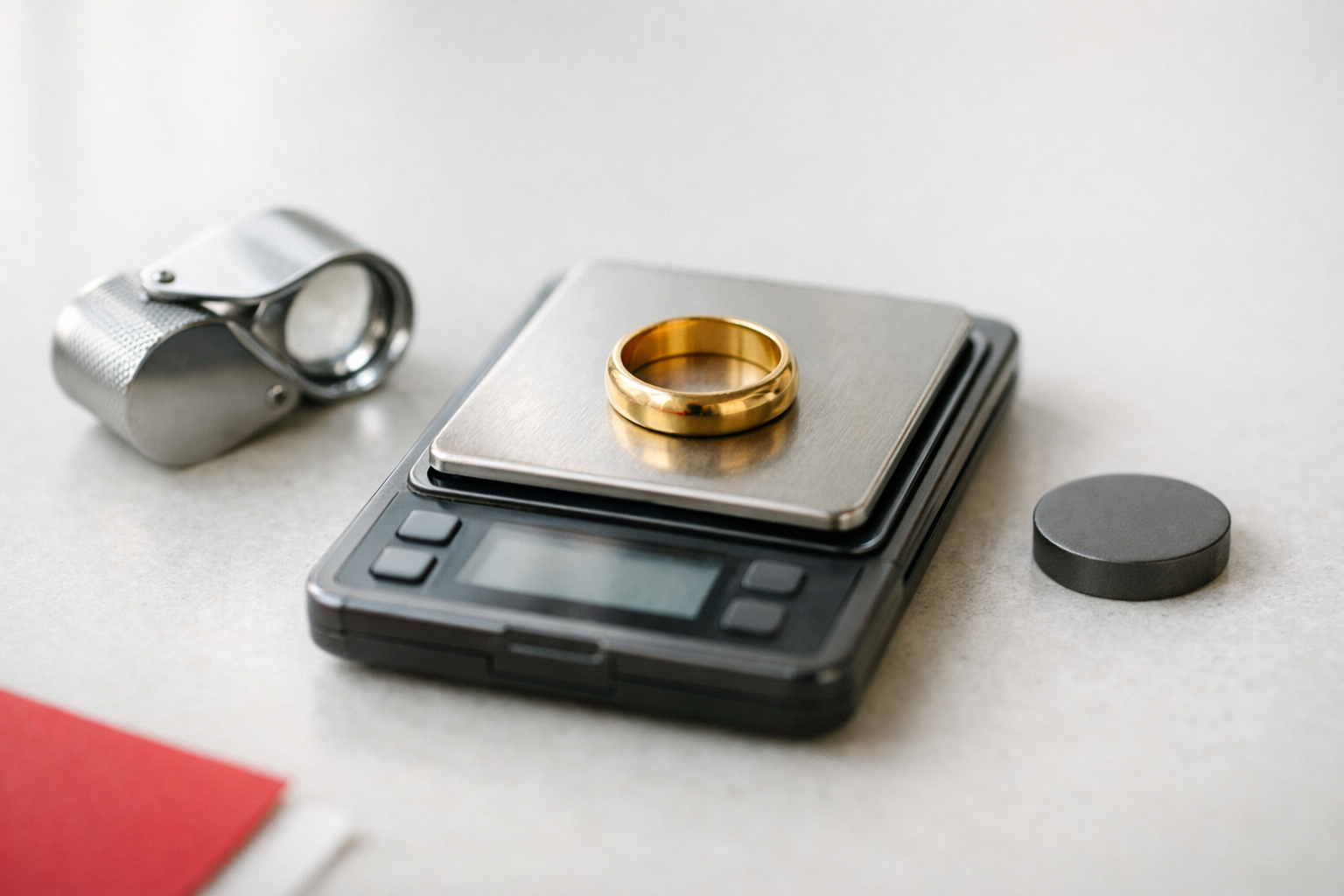
A pawn shop or jewellery cash-for-gold counter usually prices an item on melt value: what the raw gold content is worth if the item is melted down and refined, not what the finished piece might fetch as jewellery or as a collectible. The buyer weighs the item, estimates its purity (often by acid test, electronic tester, or the karat stamp if one is present and trusted), and calculates the gold content by weight. That figure is then multiplied by a price per gram, and a margin is subtracted before an offer is made.
That margin tends to be wide relative to what a bullion dealer applies, for a few structural reasons. The buyer is usually taking on resale and refining risk: unlike a government mint coin, melted scrap jewellery has no established wholesale market price of its own, so the buyer generally has to find a refiner, wait for the metal to be processed and assayed, and absorb whatever the refiner charges and whatever the market does in the meantime. A pawn shop’s core business is also broader than precious metals; it may handle electronics, tools, and other goods, and its buy price typically reflects a business model built around resale margin on used goods generally, not a tight, high-volume spread on one standardized commodity. A jewellery cash-for-gold counter, meanwhile, deals mostly in jewellery and scrap, items of mixed and often uncertain purity, rather than investment-grade bullion with a known, verified purity and a liquid wholesale market. All of this describes a common business model, not an accusation against any specific store.
How a dedicated bullion dealer typically prices an item
A dedicated bullion dealer’s core, high-volume business is buying and selling recognized investment-grade coins and bars, government mint coins such as the Gold Maple Leaf, and bars from established refiners, at a narrow spread around the live spot price. Because that dealer typically plans to resell the same recognized coin or bar largely unchanged, to another investor or into the wholesale bullion market, it has a direct incentive to price close to the live bid, since an unjustified discount would simply push sellers toward a competing dealer. Spot price moves throughout the trading day, so a bullion dealer’s buy quote is tied to the metal price at that moment, not a fixed figure set days or weeks in advance.
This site’s guide to selling bullion back to a dealer covers that buy-back process in more detail, including what identification or paperwork a dealer may require. The point that matters here is narrower: a dedicated bullion dealer and a cash-for-gold jewellery counter are different businesses with different economics, and the price gap between them for the same weight of gold can be large, even when neither side is doing anything improper.
Why jewellery is usually far below investment-grade purity
Part of the price gap is not margin at all. It is purity. Most gold jewellery sold in Canada is not anywhere close to pure gold; it is an alloy, described by its karat. Karat measures the proportion of pure gold in an item out of 24 parts. Canada’s Competition Bureau, which administers the federal Precious Metals Marking Act and its regulations, publishes the accepted decimal equivalents for the karat marks commonly used on jewellery sold in Canada:
| Karat mark | Gold content | Typical use |
|---|---|---|
| 24K | Defined as pure gold, the reference point karat is measured against. Commercially refined “24-karat” bullion is typically 99.99% fine, since absolute 100.000% purity is not achievable at scale. | Investment bullion coins and bars; rarely jewellery, since pure gold is too soft for everyday wear |
| 18K | .750, or 75.0% pure gold | Higher-end jewellery |
| 14K | .583, or 58.3% pure gold | Common jewellery, especially in North America |
| 10K | .416 to .417, or roughly 41.6% to 41.7% pure gold | Lower-cost jewellery. The minimum karat Canada allows to carry a gold quality mark is 9K. |
Source: Competition Bureau Canada, “Detailed requirements for marking of precious metals” and “Guide to the Precious Metals Marking Act and Regulations”, both checked 16 November 2026. The 24-karat purity figure is corroborated by the Royal Canadian Mint’s own current product listing for its 99.99% pure gold Maple Leaf bullion coin, checked 16 November 2026 (see Sources).
That 41.6% to 75% range sits well below the purity bar Canadian tax law uses to define investment-grade precious metal. Under the Excise Tax Act, a bar, ingot, coin, or wafer only counts as a tax-exempt “precious metal” for GST/HST purposes if it is refined to at least 99.5% purity for gold and platinum, or 99.9% for silver, and meets specific form requirements, such as recognized trading marks or government-issued coin status (Canada Revenue Agency, GST/HST Memorandum 17-1, paragraphs 29 and 30, checked 16 November 2026). The same memorandum states plainly that carat gold, sterling silver, or platinum in jewellery or chattel form does not meet that purity and form test, and is generally a taxable supply, not an exempt precious metal, for GST/HST purposes (same memorandum, paragraph 36, checked 16 November 2026).
Put together, this explains a meaningful part of why a cash-for-gold counter’s price per gram looks so much lower than the gold price quoted in the news. Spot price is quoted for pure gold. A piece of 14K jewellery is, by weight, only 58.3% gold; the rest is other metals used to harden and colour the alloy. A buyer calculating melt value on 14K jewellery and offering roughly 58% of the pure-gold price per gram, before any margin at all, is not shortchanging a seller on purity; that buyer is applying the correct math for the metal actually present. The margin layered on top of that purity discount is the part worth scrutinizing and comparing between buyers. The purity discount itself generally is not a sign of unfair dealing; it reflects the item’s actual metal content.
Practical steps before selling to a cash-for-gold counter
- Check the current spot price for gold before walking in, so a quoted price per gram can be compared against the market rather than taken on faith.
- Ask the buyer to weigh and test the item in view, rather than out of sight, and ask directly what price per gram, and what purity assumption (karat or decimal fineness), that price is based on.
- Do the arithmetic independently: multiply the item’s weight by its stated or tested purity, then by the current spot price, to see roughly what the pure gold content is worth before any margin is applied.
- Get more than one quote. Comparing offers across a couple of buyers is a simple way to see whether a given margin is reasonable or unusually wide.
- Keep investment-grade bullion coins and bars separate from jewellery in that decision. A recognized government mint coin or bar is generally better sold to a dedicated bullion dealer, or back through the original dealer’s own buy-back program, than across a jewellery cash-for-gold counter, since the two are priced on entirely different bases and a jewellery counter is generally not set up to price recognized bullion anywhere near its investment value.
Frequently asked questions
Why do cash-for-gold shops pay less than spot price?
Two separate things combine to produce a lower price. First, spot price is quoted for pure, or near-pure, gold, while most jewellery is a lower-karat alloy; 14K jewellery, for example, is only 58.3% gold by weight, so a correct melt-value calculation already prices it well under the spot figure before any margin at all. Second, on top of that correct purity discount, a cash-for-gold counter typically subtracts its own margin to cover resale and refining risk, since it usually cannot resell melted scrap the way a bullion dealer resells a recognized coin. The combination of a real purity discount and a wider margin is why the price per gram at this kind of counter can look much lower than the gold price reported in the news.
Is a cash-for-gold shop ever a reasonable choice?
It can be, particularly for mixed-karat, broken, or unwanted jewellery that has no real collector or resale value beyond its metal content, where convenience and speed matter. The main risk is not that this type of buyer is inherently dishonest; it is that a seller who does not know the item’s actual weight, purity, and the current spot price has no real way to judge whether a given offer reflects a fair margin or an unusually wide one. Testing the item, doing the arithmetic, and comparing more than one quote turns that decision from a guess into an informed one.
How do I know what my item is really worth before selling?
Start with the item’s weight in grams and its purity, taken either from a trustworthy karat stamp or from the buyer’s own test performed in view. Multiply the weight by the purity, expressed as a decimal, so 14K becomes 0.583, to get the pure gold content, then multiply that figure by the current spot price per gram to get an approximate melt value before any margin. That number is roughly the ceiling a cash-for-gold offer is being measured against, not the number a seller should expect to receive, since the buyer still needs to cover its own margin.
Should I sell bullion coins to a pawn shop?
Generally, no. A recognized investment-grade coin, such as a government mint bullion coin, is priced by a dedicated bullion dealer close to the live spot price, because reselling that exact coin to another investor is the dealer’s core, high-volume business. A pawn shop or jewellery cash-for-gold counter is typically set up to buy scrap and jewellery for melt value, and may not price, or may significantly underprice, a recognized bullion coin relative to what a dedicated bullion dealer or the coin’s original dealer buy-back program would offer. A dedicated bullion dealer, or an original dealer’s own buy-back program, is the more appropriate starting point for selling investment-grade bullion.
Sources
- Competition Bureau Canada, “Detailed requirements for marking of precious metals”, checked 16 November 2026.
- Competition Bureau Canada, “Guide to the Precious Metals Marking Act and Regulations”, checked 16 November 2026.
- Canada Revenue Agency, GST/HST Memorandum 17-1, “Definition of ‘Financial Instrument'”, paragraphs 29, 30, and 36, checked 16 November 2026.
- Royal Canadian Mint, 2026 Gold Maple Leaf, 1 oz, 99.99% pure gold (bullion), checked 16 November 2026.
About this byline
Gold in Canada is written by an editorial desk, not a single person. We are not advisers, and nothing here is personalized investment, tax or legal advice. Who writes this
Spotted an error? Tell us. We fix pages in place and say what changed.